
What Is a Customer Journey Map?

A customer journey map is a visual representation of every interaction a customer has with a brand, product, or service — from initial awareness through post-purchase. A customer journey map is essential for improving customer experience and business outcomes. When you understand customers’ behaviors, perceptions and needs as they interact with your business, you can take action to reduce friction and replicate what’s working well.
Customer journey mapping enables you to step into your customers’ shoes, identify problems and deliver what customers need, when they need it. Customer journey mapping helps you
Better understand your customers.
Identify and remedy friction points in your current journeys.
Highlight areas of opportunity and innovation to enhance existing CX.
Assess the impact of your CX improvements efforts and decide where to focus resources to better engage customers.
Customer Journey Map vs. Buyer Journey
According to Forrester, a customer journey is a customer’s path and perceptions as they pursue a goal. The path includes interactions the customer has with your organization, other organizations and other people. For example, someone who needs to get a mortgage to buy a house (goal) may use a mortgage calculator to determine what they can afford, compare mortgage rates at several banks and apply for a mortgage (the path).
Customer journeys are always about customer goals—not business goals. Customers want to activate their wireless service or open a checking account, not “be onboarded” or “be converted.” Customers experience many journeys during their relationship with an organization. When stakeholders refer to “the customer journey,” they usually mean the customer lifecycle.
When marketers refer to “the buyer journey” (or “conversion journey”), they’re referring to a prospect’s progression toward a business goal (the sale). The buyer journey is the path a prospect takes before purchasing a product or service. The buyer journey typically includes three stages in the buyer decision process: awareness (recognizing a problem), consideration (evaluating products or solutions) and decision (choosing a product or service).
Customer journeys start when a prospect becomes a paying customer. They include post-purchase interactions customers have while activating, using, paying and seeking support for the product or service.
Stages of a Customer Journey
Buyer and customer journeys occur during all stages of the customer lifecycle. Lifecycle stage names may vary by organization.
What are the five stages of the customer journey?
Awareness: Prospects realize they have a need or problem and start researching solutions. They may not yet know your brand exists. Marketers should focus on educational content and brand awareness.
Consideration: Prospects actively evaluate different solutions, options and vendors. Provide detailed, comparative content to help them make informed decisions. Case studies and product demos may influence the buyer decision process.
Decision/Purchase: Prospects make their purchase decisions. They want price transparency and an effortless, secure check out process. Make it easy for buyers to complete their purchase.
Onboarding/Retention : Customers activate, use, pay for and seek support for their products or services. Deliver simple onboarding, quick value realization and convenient payment processes. Communicate proactively and provide responsive customer support.
Loyalty/Advocacy: Customers become repeat customers and brand promoters. Offer relevant/tailored promotions and meaningful loyalty programs. Measure customer satisfaction, net promoter score, customer effort score and churn rate to evaluate CX.
Core Components of a Customer Journey Map
A customer journey map should outline these six components:
Customer personas: A customer (or buyer) persona is a semi-fictional profile that represents your ideal customer based on data and market research. Personas describe the demographics, goals, needs, behaviors and pain points for your key audiences.
Touchpoints: A touchpoint is any interaction, communication, or point of contact between a business and a customer or prospect—such as reading ads or online reviews, contacting customer support or visiting a website or physical store.
Customer Actions: A customer journey map should outline the customer’s decisions and behaviors at each step in a specific journey.
Emotions: Map how customers feel (frustrated, confused, satisfied, happy)—not just what they do—while interacting with your business. Use solicited and unsolicited data to identify friction points and customer successes that impact loyalty.
Channels: Outline the platforms customers use to interact with your brand: website, mobile app, phone calls, emails, chats with a live or virtual agent, social media and visits to a brick-and-mortar store.
Opportunities: Identify areas for process improvement (such as logins, checkout, payments) based on common friction and drop off points in significant journeys.
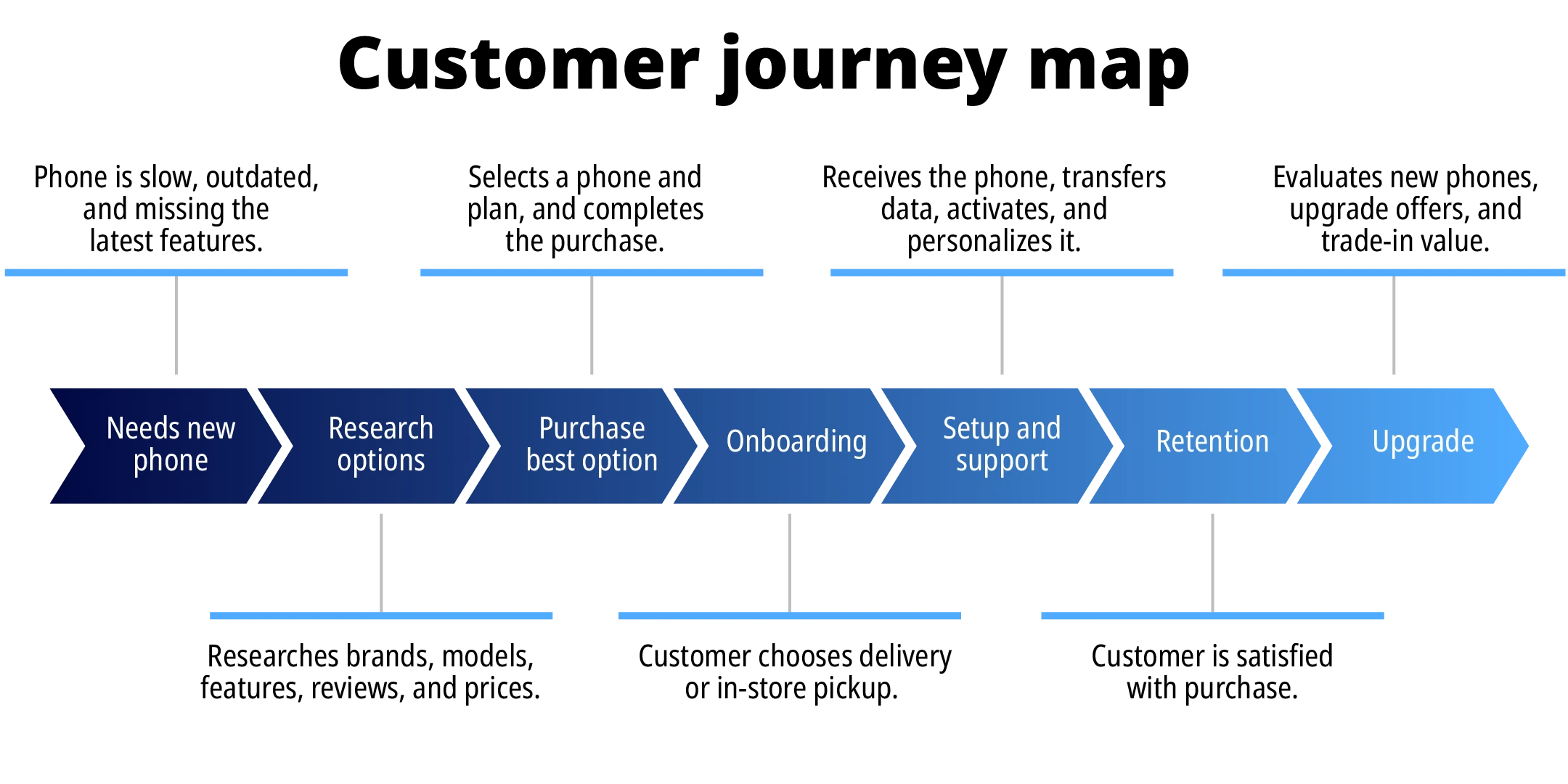
Types of Customer Journey Maps
Start the customer journey mapping process by choosing the type of map that best suits your business needs:
Current state map: This map depicts what customers do, think and feel as they interact with your business today. Because it uncovers friction points, the current state map is ideal for identifying areas for process improvement to enhance CX. Use this map when you’re mapping an existing experience.
Future state map: This map visualizes the ideal customer journey. Use this map when you’re designing new experiences or planning product launches and process/journey improvements.
Day in the life: This map depicts how your product or service fits into the customer’s daily life, helping you understand customer challenges, expectations and unmet needs.
Service blueprint: This advanced journey map adds behind-the-scenes workflows, mapping the staff interactions, internal processes and tech systems that support the customer journey. Use this map to identify and eliminate or improve pain points.
From Linear Funnel to Loyalty Loop
The traditional marketing funnel assumes a relatively linear path. Consumers begin with a broad set of potential brands, narrow their choices as they evaluate their options, and ultimately emerge with one brand at the point of purchase. While the funnel can help marketers understand where consumers are in the buying process, McKinsey recognized its limitations: “the funnel concept fails to capture all the touch points and key buying factors resulting from the explosion of product choices and digital channels, coupled with the emergence of an increasingly discerning, well-informed consumer.”
McKinsey developed the Consumer Decision Journey, a framework that describes the decision-making process as a circular journey with four phases: initial consideration; active evaluation; closure, when consumers buy brands; and postpurchase, when consumers experience them. After purchasing a product or service, the consumer builds expectations based on experience to inform the next purchase decision.
The CDJ framework features the loyalty loop. When a customer has an exceptional postpurchase experience, they skip the consideration and evaluation phases entirely the next time they need that product, going straight back to repurchase the same brand. The CDJ recognizes that influence happens before, during, and after purchase—and that post-purchase experiences can be the strongest drivers of future decisions.
Benefits of Customer Journey Mapping
Why is customer journey mapping so important?
Focusing on CX has never been more critical. “In today’s market, customer experience isn’t just a brand pillar, it is the brand,” according to PwC. Every interaction tests customer trust, and customers often vote with their wallets. In PwC’s 2025 Customer Experience Survey, 52% of consumers said they stopped using or buying from a brand because they had a bad experience with its products or services, while 29% stopped due to poor customer experience, either online or in-person.
Customers expect convenient omnichannel and personalized experiences when they interact with your brand. Deloitte research found that 67% of customers spend more money when personalization reflects an understanding of them and anticipates their needs, while 69% spend more when personalization helps them discover new products, services or content.
Customer journey mapping helps CX teams understand customer needs and expectations and deliver better, more personalized experiences that build trust and loyalty. For your business to remain competitive, you must go beyond personalization, making interactions so effortless that customers barely notice they’re making choices at all.
Customer journey mapping:
Increases customer retention: Mapping postpurchase journeys reveals pain points that may lead to churn. Addressing these problems helps you retain more customers.
Improves customer experience: Customer journey mapping pinpoints opportunities to reduce friction and improve interactions during purchase, onboarding and postpurchase/support journeys. This results in smoother customer experience, greater satisfaction and stronger loyalty.
Helps you understand customer psychology: Mapping how customers think, feel and behave as they interact with your brand provides insight into their motivations, pain points and decision-making. When you understand customer needs and expectations better, you can offer personalized solutions and make valuable connections that build loyalty.
Identifies high-impact touchpoints: Journey mapping helps CX teams determine which interactions have the greatest influence on customer decisions and satisfaction. This allows teams to prioritize resources, eliminate unnecessary steps and improve the moments that matter most.
Builds competitive advantage: A detailed view of customer journeys reveals opportunities to differentiate experiences. You can use journey maps to identify weaknesses in competitors' experiences, create more personalized journeys and develop communications tailored to customers.
Fosters team alignment. A customer journey map gives teams across your organization a shared view of the customer experience, helping departments better understand how their roles contribute to the overall journey.
Informs product development: Customer journey insights can reveal opportunities for new features, enhancements and improvements that better address customer needs.
Supports more effective marketing: Understanding customer needs enables businesses to deliver more relevant campaigns and messages, increasing engagement and sales.
How to Create a Customer Journey Map
Mapping customer journeys may seem like a long, technical process, but it doesn’t have to be. Follow these four steps to effectively map customer journeys:
1. Establish Customer Personas
By creating profiles of semi-fictional personas who represent typical customers, you can predict how your real-world customers will engage with your brand. Because your customer base isn’t homogenous, the personas can vary, as well. Base personas on current customers, big spenders or new customers you have worked with (or want to work with). Identify these characteristics for each persona:
Name
Age
Job Title
Family status
Work and personal goals
Habits
Additional data collected through surveys or interviews can help you create multiple profiles that represent your diverse audience. Employees from various departments in your organization can provide valuable insights that add depth to each persona.
2. Select a Customer Journey to Map
Decide which customer journey you want to focus on, then build out the details that will help you create that map. Consider journeys that occur at all stages of the customer lifecycle, including post-acquisition.
Identify the journeys that have the most impact on customer experience, loyalty and business outcomes. Financial service organizations might focus on the “opening a new account” journey, while telecoms might map the bill payment journey (where bill confusion damages customer satisfaction and increases contact center calls).
3. Work through the Mapping Process
As you develop the customer journey map, be sure to include the six components described above.
Ask your team these questions to help you understand and map a specific customer journey:
Which employees and people are involved in this customer journey? For example, journeys might include the customer, sales representative, contact center agent and social media team.
What happens during the journey?
What do customers feel? Are they frustrated, confused or anxious?
What are their attitudes?
What is the most significant moment during the journey?
What is the biggest emotional load?
What people and processes are involved at the make-or-break moment?
What are your customers’ needs?
What are they getting at each step, particularly at the most loaded moment?
How do their needs and attitudes change if things don’t go as planned?
These answers will help you respond better when the journey breaks.
How will you measure the effectiveness of your CX improvement efforts?
What key performance indicators (KPIs) will help you evaluate the success of a journey?
How will you track progress and measure CX?
4. Optimize the Journey at Every Stage
While mapping a journey, you may discover multiple friction points. Take time to brainstorm with your team about how to eliminate or reduce friction at every step of the customer journey. Record the suggested solutions and then evaluate them to choose the most feasible ones, considering:
Is the solution practical?
Is it doable and sustainable?
Is it desirable?
Will the solution help differentiate your company from its competition?
Then test and tweak the solution to optimize the customer journey.
The Data Behind Great Maps: Solicited vs. Unsolicited
Accurate data gives you a realistic picture of how customers act. This information enables you to improve processes and enhance customer experience. You must leverage multiple data sources to get a holistic view of customer behavior. To optimize customer journey mapping, use both solicited and unsolicited data to gain deeper insights.
Requested (Solicited) Data
Consumer feedback your organization requests—such as through forms or Net Promoter Score and Customer Satisfaction surveys—is valuable for customer journey mapping. You can also ask for customer feedback through social media channels. Gathering solicited feedback allows you to translate valuable, accessible data into actionable customization preferences almost immediately. Solicited data can quickly uncover friction points, as unhappy customers are often eager to voice their complaints.
Solicited information helps you understand the customer’s perspective without making assumptions about the meaning of their actions. Of course, customers may not share everything with you. Some people may only air their grievances, while others may highlight positive interactions with your business but neglect to mention negative ones that would help you identify areas for process improvement.
Solicited feedback is helpful, with a few limitations. When asking customers for feedback, remember:
Timing is everything: The best time to get solicited feedback is when an interaction is fresh in the customer’s mind. That said, knowing when to ask for feedback can be tricky if you don’t know what journey paths customers may take.
Feedback is limited in scope: Consumers typically tell you about one specific encounter, addressing touchpoints related to that experience. Feedback gives you a snapshot—not information about a customer journey as a whole.
Responses may not represent behavior: You are taking the customer’s word regarding what they plan to do. What they actually do may be different. Solicited feedback only gives you a piece of the puzzle.
Feedback may be skewed: Insights are limited when the sample size is small. The responders may not represent your customer base.
Unsolicited Data
Unsolicited (unprompted) data refers to information customers provide without being directly asked for it—such as spontaneous customer complaints, unprompted reviews or random social media mentions. Unsolicited feedback provides an unfiltered, broader view of the customer experience, sometimes revealing pain points, preferences, expectations, and emotions that customers may not share through solicited feedback. Unsolicited data is valuable for monitoring brand reputation, identifying pain points and gauging overall sentiment.
Natural language understanding (NLU) and sentiment analysis tools analyze vast amounts of unstructured data (e.g., call or chat transcripts), identifying customer intent, key themes, emotions and attitudes.
You can gather unsolicited data from various sources:
Website search data
Social media channels
Third-party review websites
Call transcripts (contact center)
Chat transcripts
Frontline staff feedback
Operational sources (e.g., Interactive Voice Response system abandonment)
Unsolicited feedback
Reflects genuine customer opinions and experiences without biases that may be introduced during the survey or interview process.
Provides immediate insights into customer sentiment and emerging issues.
Captures a broad range of customer experiences and viewpoints across various channels.
Often includes rich contextual information, such as specific product or service experiences.
How to Fix Five Common Journey Mapping Mistakes
Mapping based on assumptions, not data. Internal team opinions about how customers act may be wrong. Use first-party customer data and journey analytics for an accurate view of what happens during customer interactions.
Failing to connect the journey map to action or orchestration. Building a journey map isn’t enough. If you don’t turn the insights into improvements, the map is useless. Turn static visuals into better experiences by using map insights to guide business decisions and process improvements (e.g., invest in a new payment processing system to improve the payment experience).
Treating journeys as linear. Many journeys don’t proceed neatly from start to finish. Someone who’s applying for a personal loan may start completing the application on their phone, stop when they don’t have the required documents with them, resume the application later using their laptop, and then call customer service with a question about additional documentation. Account for looping paths, omnichannel complexity and online to offline (or vice versa) channel transitions when mapping a journey.
Treating journey maps as a one-time project. A static journey map becomes outdated when customer behaviors (e.g., preferred engagement channels), products/services or internal processes change. Evaluate and update journey maps regularly, adding new pain points and touchpoints as feedback comes in.
Failing to assign ownership to internal teams. Failing to assign clear ownership turns customer journey maps into orphaned documents that nobody maintains, acts upon, or holds accountable. Designate a journey owner for each key journey.
Customer Journey Examples
The most significant customer journeys vary by industry. Map and orchestrate these journeys to improve customer experience and loyalty and reduce costs.
Industry | Challenges | Journeys to Map and Orchestrate |
|---|---|---|
Financial Services | Silent attrition: Customers gradually shift their business to other banks without closing their accounts. | Apply for a loan/mortgage/credit card Receive and activate cards Receive notification of exceeding overdraft limit Receive proactive alerts about suspicious behavior Report missing or stolen card |
Telecommunications/Cable/Broadband | Churn: Frequent service outages and poor customer service are leading causes of cancellation. Bill confusion: Hidden fees, changes in monthly bills, and unexpected rate increases after promotional periods end damage trust and lead to costly contact center calls. | Receive and pay bills Enquire about bills, services or charges Schedule service appointments Receive proactive service outage notifications Receive notification of exceeding allowance Renew and upgrade contract |
Utilities | Late payments can lead to late fees and service disconnection for customers. | Receive and pay bills Pay late charges and fees Receive proactive service outage notifications |
How CSG Xponent Helps You Orchestrate Customer Journeys
CSG Xponent is an intelligent customer experience platform that uses real-time data to personalize every touchpoint at an individualized level. It orchestrates departments and channels, anticipating customers' needs and delivering the right message, at the right time, in the right channel. Powered by a decisioning engine, Xponent leverages real-time insights and analytics to guide customers to the next best action.
This award-winning solution goes beyond creating and replicating a series of interactions. It provides context and automates custom experiences that customers only get from innovative brands.
CSG Xponent provides:
Quick launches: Our prebuilt journeys streamline the mapping process and get you started quickly.
Real-time interactions: Xponent builds brand loyalty and advocacy by delivering highly personalized communications in real time.
Enhanced CX optimization: With CSG Xponent, you can identify where customers drop off or convert, helping you improve processes to boost satisfaction, loyalty and sales.
CSG has helped thousands of organizations provide exceptional customer experiences. We leverage over four decades of expertise to help you evaluate and optimize your organization’s customer journey performance.
Speak to a CSG expert today to see how customer journey orchestration can enhance your company’s CX.